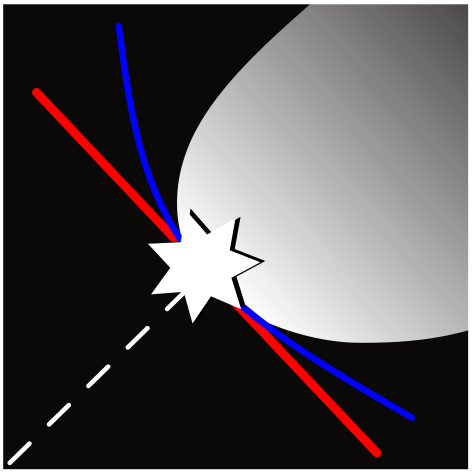
"""Second-order reliability approximations at a FORM design point."""
from typing import Literal
import numpy as np
from scipy.stats import norm as normal
from scipy.special import log_ndtr, ndtri_exp
import pystra as _pystra
from .form import FORM
from .analysis import AnalysisObject, _check_on_failure
from ._form_reuse import _check_form, _check_coordinates, _FORMReuse
from ..errors import AnalysisError, ModelError
from ..options import FORMOptions, SORMOptions
from ..results import FORMResult, SORMResult
__all__ = ["SORM"]
[docs]
class SORM(_FORMReuse, AnalysisObject):
r"""Second-order reliability method (SORM).
Approximates the failure surface in standard normal space using a
quadratic surface, improving on the linear FORM approximation. Two
approaches are available:
**Curve-fitting** (``fit="curve"``, default): computes the Hessian of
the limit-state function at the design point, extracts principal
curvatures as eigenvalues, and applies the Breitung formula.
**Point-fitting** (``fit="point"``): locates fitting points directly
on the failure surface on both sides of each principal axis using Newton
iteration, then computes curvatures from their positions. This yields
asymmetric curvatures (different on the positive and negative sides of
each axis).
Both methods report the Breitung [Breitung1984]_ and the
Hohenbichler-Rackwitz [Hohenbichler1988]_ failure probabilities and
generalized reliability indices.
Parameters
----------
model : StochasticModel
The stochastic model with random variables and correlations.
limit_state : LimitState
The limit-state function.
options : SORMOptions, optional
The fit, the reported formula and the Hessian step.
form : FORM, optional
A completed, converged FORM analysis, whose design point,
transformation and settings SORM reuses. If ``None``, :meth:`run`
first runs FORM with ``options.form``.
on_failure : {"raise", "return"}, default "raise"
On nonconvergence, raise :class:`~pystra.AnalysisError`, which carries
the unconverged record in ``.result``, or return that record.
Notes
-----
:meth:`run` returns a :class:`~pystra.results.SORMResult` with the
curvatures and each formula's probability.
"""
_options_type = SORMOptions
def __init__(
self,
model: "_pystra.StochasticModel",
limit_state: "_pystra.LimitState",
*,
options: "_pystra.SORMOptions | None" = None,
form: "_pystra.FORM | None" = None,
on_failure: Literal["raise", "return"] = "raise",
) -> None:
if form is not None and not isinstance(form, FORM):
raise TypeError("form must be a FORM analysis")
self.form = form
super().__init__(model, limit_state, options)
self.on_failure = _check_on_failure(on_failure)
if form is not None and self.options.form != FORMOptions():
raise ModelError(
"options.form applies only when SORM runs FORM; "
"a supplied FORM analysis keeps its own settings"
)
self._reset_results()
def _reset_results(self):
"""Invalidate previous SORM output before attempting another run."""
self._results_valid = False
self._betaHL = None
self._kappa = None
self._kappa_pf = None
self._fit_type = None
self._pf2_breitung = None
self._betag_breitung = None
self._pf2_breitung_m = None
self._betag_breitung_m = None
self._undefined = set()
def _form_options(self):
return (
self.options.form
if self._supplied_form is None
else self._supplied_form.options
)
def _dependence(self):
options = self._form_options()
return options.transform, options.rosenblatt_order
def _settings(self):
return self._form_options()
def _prepare_run(self, fit_type):
"""Run FORM if needed and require a converged design point."""
self._reset_results()
self._n_evaluations = 0
if self._supplied_form is not None and self.options.form != FORMOptions():
raise ModelError(
"options.form applies only when SORM runs FORM; "
"a supplied FORM analysis keeps its own settings"
)
if self._supplied_form is None:
form = FORM(
self.model,
self.limit_state,
options=self.options.form,
on_failure="return",
)
self._form = form
form.run()
_check_form(self.form, self.model, self.limit_state)
if (
self._supplied_form is None
and type(self).init_run is AnalysisObject.init_run
):
# This run owns a freshly prepared FORM with exactly these options.
# Reuse its factorization; an explicitly supplied FORM still receives
# the independent coordinate check below.
self._nrv = self.model.n_marg
self.transform = self.form.transform
if self.transform.standard_space != "normal":
raise ValueError(
"This analysis requires independent normal space; select Rosenblatt for this copula"
)
else:
self.init_run()
_check_coordinates(self.form, self.transform)
self._fit_type = fit_type
[docs]
def run(self) -> "_pystra.SORMResult":
"""Run SORM with the fit in ``options.fit``.
Curve fitting uses the eigenvalues of the Hessian at the design
point; point fitting locates points on the failure surface by Newton
iteration. FORM is run first if no FORM analysis was supplied.
Returns
-------
SORMResult
The immutable record of this run.
Raises
------
AnalysisError
If FORM did not converge, a fitting point cannot be found, or the
formula is undefined for the fitted curvatures, unless
``on_failure="return"``.
"""
try:
if self.options.fit == "curve":
result = self._run_curvefit()
else:
result = self._run_pointfit()
except AnalysisError as error:
result = self._failed_result(str(error))
if self.on_failure == "raise":
raise AnalysisError(str(error), result) from error
return result
if not result.converged and self.on_failure == "raise":
raise AnalysisError(result.message, result)
return result
def _failed_result(self, message):
"""Return the record of a fit that could not be completed."""
return SORMResult(
method="SORM",
status="not_converged",
message=message,
n_limit_state_evaluations=self._n_evaluations,
variable_names=tuple(self.model.get_variables()),
failure_probability=None,
beta=None,
form=FORMResult.from_analysis(self.form),
fit=self.options.fit,
curvatures=None,
formula=self.options.formula,
options=self.options,
approximations={"breitung": None, "modified_breitung": None},
)
def _run_curvefit(self):
"""Run curve fitting and return a :class:`SORMResult`; FORM must have converged."""
self._prepare_run("cf")
hess_G = self._compute_hessian()
R1 = self._orthonormal_matrix()
A = R1 @ hess_G @ R1.T / np.linalg.norm(self.form._gradient)
kappa, _ = np.linalg.eig(A[:-1, :-1])
kappa = np.real_if_close(kappa, tol=1e7)
self._betaHL = self.form._beta
self._kappa = np.sort(kappa)
self._pf_breitung(self._betaHL, self._kappa)
self._pf_breitung_m(self._betaHL, self._kappa)
self._results_valid = True
return self._result()
def _run_pointfit(self):
"""Run SORM analysis using point-fitting.
Finds fitting points on the limit-state surface on both the positive
and negative sides of each principal axis in the rotated standard
normal space. Curvatures are computed from the positions of these
points, producing asymmetric curvatures returned in
:attr:`SORMResult.curvatures`.
The generalized Breitung formula for asymmetric curvatures is:
.. math::
p_{f2} = \\Phi(-\\beta) \\prod_{i=1}^{n-1} \\frac{1}{2}
\\left[ (1 + \\beta \\kappa_i^+)^{-1/2}
+ (1 + \\beta \\kappa_i^-)^{-1/2} \\right]
Notes
-----
Based on the point-fitting implementation contributed by
Henry Nguyen (Monash University, PR #65).
See Also
--------
SORMOptions : Select the Hessian-based alternative with ``fit="curve"``.
Raises
------
AnalysisError
If the FORM analysis has not run or did not converge successfully,
or a fitting point cannot be found.
"""
self._prepare_run("pf")
beta = self.form._beta
nrv = self.form._alpha.shape[1]
R1 = self._orthonormal_matrix()
marg = self.model.get_marginal_distributions()
# Step coefficient controlling trial point distance from design point
abs_beta = abs(beta)
if abs_beta < 1:
k = 1.0 / abs_beta
elif abs_beta <= 3:
k = 1.0
else:
k = 3.0 / abs_beta
kappa_minus = np.zeros(nrv - 1)
kappa_plus = np.zeros(nrv - 1)
for i in range(nrv - 1):
kappa_minus[i] = self._find_fitting_point(i, -1, beta, k, R1, marg)
kappa_plus[i] = self._find_fitting_point(i, +1, beta, k, R1, marg)
# Store results
self._betaHL = self.form._beta
self._kappa_pf = np.vstack([kappa_minus, kappa_plus])
self._kappa = np.sort(0.5 * (kappa_minus + kappa_plus))
# Compute failure probabilities
self._pf_breitung_pf(beta, kappa_minus, kappa_plus)
self._pf_breitung_m_pf(beta, kappa_minus, kappa_plus)
self._results_valid = True
return self._result()
def _result(self):
"""Return the immutable record of the completed fit."""
approximations = {
"breitung": self._pf2_breitung,
"modified_breitung": self._pf2_breitung_m,
}
for name in self._undefined:
approximations[name] = None
estimate = approximations[self.options.formula]
# The index comes from the log probability, so it stays finite when
# the probability itself underflows to zero.
index = {
"breitung": self._betag_breitung,
"modified_breitung": self._betag_breitung_m,
}[self.options.formula]
return SORMResult(
method="SORM",
status="converged" if estimate is not None else "not_converged",
message=(
"Fitted"
if estimate is not None
else f"The {self.options.formula.replace('_', ' ')} formula is undefined for the fitted curvatures"
),
n_limit_state_evaluations=self._n_evaluations,
variable_names=tuple(self.model.get_variables()),
failure_probability=estimate,
beta=float(index) if estimate is not None else None,
form=FORMResult.from_analysis(self.form),
fit="curve" if self._fit_type == "cf" else "point",
curvatures=self._kappa if self._fit_type == "cf" else self._kappa_pf,
formula=self.options.formula,
options=self.options,
approximations=approximations,
)
def _find_fitting_point(self, axis, sign, beta, k, R1, marg, max_iter=50, tol=1e-6):
"""Find a fitting point on the failure surface and return its curvature.
Uses Newton iteration along the last axis of the rotated standard
normal space to locate a point where :math:`G = 0`, keeping the
coordinate on the fitting *axis* fixed.
Parameters
----------
axis : int
Index of the rotated axis (``0`` to ``nrv - 2``).
sign : {-1, +1}
Side of the axis: ``-1`` for negative, ``+1`` for positive.
beta : float
Reliability index from FORM.
k : float
Step coefficient controlling trial point distance.
R1 : ndarray
Orthonormal rotation matrix, shape ``(nrv, nrv)``.
marg : list
Marginal distributions from the stochastic model.
max_iter : int, optional
Maximum Newton iterations (default 50).
tol : float, optional
Convergence tolerance on ``|G|`` (default ``1e-6``).
Returns
-------
float
Curvature :math:`a_i = 2 (u'_n - \\beta) / (u'_i)^2` for the
given axis and side.
Raises
------
AnalysisError
If the search gradient vanishes or Newton iteration does not
converge within *max_iter* steps.
"""
nrv = R1.shape[0]
# Trial point in rotated space: u'[axis] = sign*k*beta, u'[-1] = beta
u_prime = np.zeros(nrv)
u_prime[axis] = sign * k * beta
u_prime[-1] = beta
G_val = None
for iteration in range(max_iter):
# Transform to standard normal space
u = R1.T @ u_prime
# Transform to physical space
x = self.transform.u_to_x(u, marg)
x_col = x[:, np.newaxis] if x.ndim == 1 else x
# Evaluate LSF and gradient in u-space
G, grad = self._evaluate_lsf(x_col, calc_gradient=True)
G_val = np.squeeze(G)
grad_u = np.squeeze(grad)
if abs(G_val) < tol:
break
# Gradient in rotated space
grad_rot = R1 @ grad_u
# Newton update along the last axis (n-th direction)
if abs(grad_rot[-1]) < 1e-12:
raise AnalysisError(
f"Point-fitting: near-zero gradient component along the "
f"n-th axis at axis={axis}, sign={sign}. The limit state "
f"surface may be tangent to the search direction."
)
u_prime[-1] -= G_val / grad_rot[-1]
else:
raise AnalysisError(
f"Point-fitting did not converge for axis={axis}, sign={sign} "
f"after {max_iter} iterations (|G| = {abs(G_val):.2e})."
)
# Compute curvature from the converged fitting point
u_prime_i = u_prime[axis]
u_prime_n = u_prime[-1]
if abs(u_prime_i) < 1e-12:
return 0.0
return 2.0 * (u_prime_n - beta) / (u_prime_i**2)
def _pf_breitung_pf(self, beta, kappa_minus, kappa_plus):
"""Breitung formula for point-fitting with asymmetric curvatures.
Parameters
----------
beta : float
Reliability index.
kappa_minus : ndarray
Curvatures on the negative side of each axis.
kappa_plus : ndarray
Curvatures on the positive side of each axis.
"""
terms_plus = 1 + beta * kappa_plus
terms_minus = 1 + beta * kappa_minus
is_invalid = np.any(terms_plus <= 0) or np.any(terms_minus <= 0)
if not is_invalid:
log_pf = log_ndtr(-beta) + np.sum(
np.logaddexp(-0.5 * np.log(terms_plus), -0.5 * np.log(terms_minus))
- np.log(2.0)
)
self._pf2_breitung = float(np.exp(log_pf))
self._betag_breitung = float(-ndtri_exp(log_pf))
else:
self._undefined.add("breitung")
self._pf2_breitung = 0.0
self._betag_breitung = 0.0
def _pf_breitung_m_pf(self, beta, kappa_minus, kappa_plus):
"""Hohenbichler-Rackwitz modified Breitung for asymmetric curvatures.
Parameters
----------
beta : float
Reliability index.
kappa_minus : ndarray
Curvatures on the negative side of each axis.
kappa_plus : ndarray
Curvatures on the positive side of each axis.
"""
psi = np.exp(normal.logpdf(beta) - log_ndtr(-beta))
terms_plus = 1 + psi * kappa_plus
terms_minus = 1 + psi * kappa_minus
is_invalid = np.any(terms_plus <= 0) or np.any(terms_minus <= 0)
if not is_invalid:
log_pf = log_ndtr(-beta) + np.sum(
np.logaddexp(-0.5 * np.log(terms_plus), -0.5 * np.log(terms_minus))
- np.log(2.0)
)
self._pf2_breitung_m = float(np.exp(log_pf))
self._betag_breitung_m = float(-ndtri_exp(log_pf))
else:
self._undefined.add("modified_breitung")
self._pf2_breitung_m = 0.0
self._betag_breitung_m = 0.0
def _pf_breitung(self, beta, kappa):
"""
Calculates the probability of failure and generalized reliability
index using [Breitung1984]_ formula. This formula is good for higher
values of beta.
"""
is_invalid = np.any(kappa < -1 / beta)
if not is_invalid:
log_pf = log_ndtr(-beta) - 0.5 * np.sum(np.log1p(beta * kappa))
self._pf2_breitung = float(np.exp(log_pf))
self._betag_breitung = float(-ndtri_exp(log_pf))
else:
self._undefined.add("breitung")
self._pf2_breitung = 0.0
self._betag_breitung = 0.0
def _pf_breitung_m(self, beta, kappa):
"""
Calculates the probability of failure and generalized reliability
index using Brietung's formula ([Breitung1984]_) as modified by Hohenbichler and
Rackwitz [Hohenbichler1988]_. This formula is better for lower values of beta.
"""
k = np.exp(normal.logpdf(beta) - log_ndtr(-beta))
is_invalid = np.any(kappa < -1 / k)
if not is_invalid:
log_pf = log_ndtr(-beta) - 0.5 * np.sum(np.log1p(k * kappa))
self._pf2_breitung_m = float(np.exp(log_pf))
self._betag_breitung_m = float(-ndtri_exp(log_pf))
else:
self._undefined.add("modified_breitung")
self._pf2_breitung_m = 0.0
self._betag_breitung_m = 0.0
def _compute_hessian(self, diff_type=None):
"""
Computes the matrix of second derivatives using forward finite
difference, using the evaluation of the gradient already done
for FORM, at the design point
Could use numdifftools as external library instead
"""
h = 1 / self.options.ffd_parameter
nrv = self.form._alpha.shape[1]
hess_G = np.zeros((nrv, nrv))
if diff_type is None:
# Differentiation based on the gradients
x0 = self.form._design_point_x()
_, grad_g0 = self._evaluate_lsf(x0[:, np.newaxis], calc_gradient=True)
u0 = self.form._u
for i in range(nrv):
u1 = np.copy(u0)
u1[i] += h
x1 = self.transform.u_to_x(u1, self.model.get_marginal_distributions())
_, grad_g1 = self._evaluate_lsf(x1[:, np.newaxis], calc_gradient=True)
hess_G[:, i] = ((grad_g1 - grad_g0) / h).reshape(nrv)
else:
# FERUM-implementation using a mix of central and foward diffs
# It would be good if u_to_x could take an nvr x nx matrix and
# return the corresponding x-matrix. This would make it easier to
# add more numerical differentiation schemes.
u0 = self.form._u
all_x_plus = np.zeros((nrv, nrv))
all_x_minus = np.zeros((nrv, nrv))
all_x_both = np.zeros((nrv, int(nrv * (nrv - 1) / 2)))
marg = self.model.get_marginal_distributions()
for i in range(nrv):
# Plus perturbation and transformation
u_plus = np.copy(u0)
u_plus[i] += h
x_plus = self.transform.u_to_x(u_plus, marg)
all_x_plus[:, i] = x_plus
# Minus perturbation and transformation
u_minus = np.copy(u0)
u_minus[i] -= h
x_minus = self.transform.u_to_x(u_minus, marg)
all_x_minus[:, i] = x_minus
for j in range(i):
# Mixed perturbation and transformation
u_both = np.copy(u_plus)
u_both[j] += h
x_both = self.transform.u_to_x(
u_both, self.model.get_marginal_distributions()
)
all_x_both[:, int((i - 1) * (i) / 2) + j] = x_both
# Assemble all x-space vecs, solve for G, then separate
all_x = np.concatenate((all_x_plus, all_x_minus, all_x_both), axis=1)
all_G, _ = self._evaluate_lsf(all_x, calc_gradient=False)
all_G = all_G.squeeze()
all_G_plus = all_G[:nrv]
all_G_minus = all_G[nrv : 2 * nrv]
all_G_both = all_G[2 * nrv : :]
G = self.form._G
# Now use finite differences to estimate hessian
for i in range(nrv):
# Second-order central difference
hess_G[i, i] = (all_G_plus[i] - 2 * G + all_G_minus[i]) / h**2
for j in range(i):
# Second order forward difference
hess_G[i, j] = (
all_G_both[int((i - 1) * (i) / 2) + j]
- all_G_plus[j]
- all_G_plus[i]
+ G
) / h**2
hess_G[j, i] = hess_G[i, j]
return hess_G
def _evaluate_lsf(self, x, calc_gradient=False, u_space=True):
"""
For use in computing the Hessian without altering the FORM object.
Considers the coord transform so the limit-state function is evaluated
in physical coordinates, but gradient returned in u-space.
This code already in FORM, and a more integrated approach would put
this in a base class for common use.
"""
G, grad = 0, 0
x0 = np.copy(x) # avoid modifying argument in func calls below
if calc_gradient:
G, grad = self._lsf(x0, gradient=True)
grad = np.transpose(grad)
if u_space:
marg = self.model.get_marginal_distributions()
u = self.transform.x_to_u(x0, marg)
J_u_x = self.transform.jacobian_u_wrt_x(u, x0, marg)
J_x_u = np.linalg.inv(J_u_x)
grad = np.dot(grad, J_x_u)
else:
G, _ = self._lsf(x0, gradient=True)
return G, grad
def _orthonormal_matrix(self):
"""
Computes the rotation matrix of the standard normal coordinate
space where the design point is located at Beta along the last
axis.
"""
alpha = self.form._alpha.ravel()
nrv = len(alpha)
# Preserve the established tangent axes away from degeneracy. If
# alpha is orthogonal to the last coordinate, omit its largest
# component's axis instead, so the seed vectors remain independent.
pivot = nrv - 1
if abs(alpha[pivot]) <= np.sqrt(np.finfo(float).eps):
pivot = int(np.argmax(np.abs(alpha)))
axes = np.eye(nrv)
A = np.column_stack(
[alpha, *[axes[i] for i in reversed(range(nrv)) if i != pivot]]
)
Q = self._gram_schmidt(A)
# And undo this rotation with a final 90 dgree rotation as order of
# the column vector entries is not relevant
R1 = np.rot90(Q)
return R1
def _gram_schmidt(self, A):
"""
Creates an orthonormal matrix using the modified Gram-Schmidt process.
Note that QR decomposition doesn't work for this application; while
it does return an orthonormal matrix, the signs are different
to the modified Gram Schmidt. The signs should be arbitrary, but the
resulting rotation matrix does care cabout the signs of the Q, since
it is based on the correct direction of the beta vector [Madsen1986]
"""
A = np.asarray(A, dtype="float")
nvr = A.shape[0]
Q = np.zeros(A.shape)
for j in range(nvr):
q = A[:, j]
for i in range(j):
rij = np.dot(q, Q[:, i])
q = q - rij * Q[:, i]
rjj = np.linalg.norm(q, ord=2)
if np.isclose(rjj, 0.0):
raise ValueError("Singular rotation matrix")
else:
Q[:, j] = q / rjj
return Q